
I gave up on the Rubik’s Cube in 2003. Then again in 2011. And once more in 2018.
Each time, the story was the same. I’d find a new tutorial, get excited, make it through two layers, hit a wall, stare at the screen for 20 minutes trying to decode what “R U R’ U’” meant while the cube in my hands went cold, and eventually put it back on the shelf.
I know I’m not alone. Over 450 million Rubik’s Cubes have been sold worldwide. Fewer than 6% of the people who have handled one can actually solve it. That means hundreds of millions of cubes are sitting in drawers, desks, and junk boxes right now—abandoned by people who tried and gave up.
If you are one of those people, this article is for you. Not because I’m going to teach you how to solve the cube (that comes later). But because the reasons you quit probably have nothing to do with what you think.
The Five Real Reasons People Quit
After years of giving up and starting over, and after reading hundreds of stories from people in the same boat, I can now see the pattern clearly. Almost everyone quits for one of five specific reasons. None of them is “I’m not smart enough.”
1. The Notation Wall
Open any Rubik’s Cube tutorial and within the first two minutes, you see something like this:
R U R’ U’ F’ U F
For an experienced cuber, this is a simple, elegant shorthand. For a beginner, it is a brick wall made of random letters.
R means the right face. U means the upper face. The apostrophe means counterclockwise. But when you are holding a physical cube in your hands, trying to figure out which face is “right” while the tutorial keeps moving, this notation feels less like a shortcut and more like a second puzzle layered on top of the first one.
Many people never get past this moment. They feel like they need to learn a new language before they can even begin solving the puzzle, and that feels like too much.
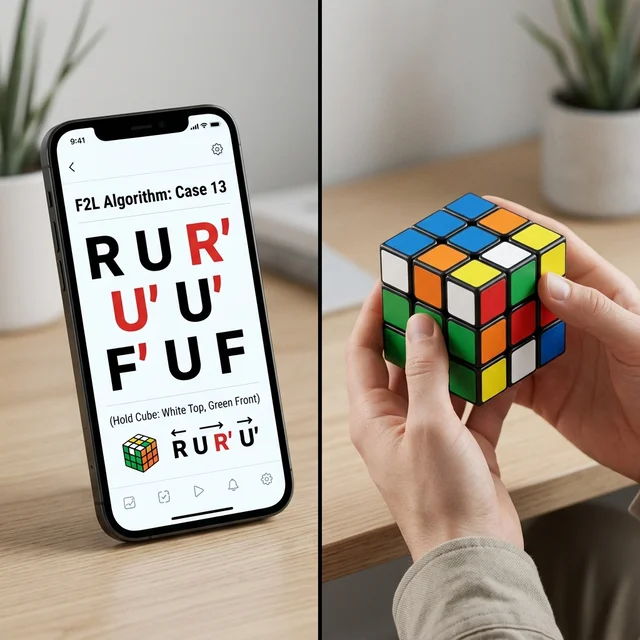 Above: R U R’ U’ — to a beginner, Rubik’s Cube notation feels like a foreign language you didn’t sign up to learn.
2. The Last Layer Cliff
The first two layers of the Rubik’s Cube are manageable. You can look at a piece, see where it needs to go, and think your way through it with a bit of logic. It feels like solving a puzzle.
Then you reach the last layer, and everything changes.
The last layer requires you to memorize specific sequences of moves and execute them on faith. You don’t understand why they work. You can’t see the logic. You just have to trust the process and repeat the steps exactly as shown. For many people—especially those who like to understand what they’re doing—this shift from thinking to memorizing is deeply unsatisfying.
One Reddit user who quit after three years of trying put it simply: “I finally gave up. I realized just some people aren’t able to do some sort of things and it’s OK.”
The cruel irony is that they were probably right at the edge of solving it. The last layer is the hardest to learn but the fastest to execute once you know the steps. Most people quit within sight of the finish line.
3. The Hands Problem
Here is something that sounds trivial but kills the learning process: solving a Rubik’s Cube requires two hands.
That means every time you need to check the tutorial, you have to put the cube down. Then you have to pick it back up, figure out where you were, reorient the cube to match the screen, and try to continue. If you lose your place—which you will—you either start the step over or start the entire solve over.
This constant picking up and putting down breaks your flow, kills your confidence, and stretches a 10-minute learning session into an hour of frustration. It sounds like a small thing, but it is the most underrated reason people give up.
4. The Broken Cube Trap
This one is devastating because you don’t even know it’s happening.
If your Rubik’s Cube was ever dropped, taken apart, or aggressively turned, a single piece can shift into an impossible position. When this happens, the cube becomes mathematically unsolvable. No algorithm will fix it. No tutorial will save you.
But you don’t know that. You just know that the last step isn’t working. You run the algorithm again and again. The same pieces keep cycling. You assume you are making a mistake. You start over. Same result. You start over again.
A randomly reassembled Rubik’s Cube has only an 8.3% chance of being solvable. That means if your cube was ever taken apart—by a curious child, after a drop, or by you trying to “cheat” years ago—there is a 91.7% chance it is physically impossible to solve.
Imagine spending an evening on a puzzle that was broken before you started. This happens to people all the time, and most never find out.
For more on this, see: Why Does My Rubik’s Cube Have One Wrong Piece?
5. Tutorial Overload
Search “how to solve a Rubik’s Cube” on YouTube and you get thousands of results. Each one uses slightly different notation, slightly different terminology, and a slightly different method. Some start with the white cross, some don’t. Some use the beginner method, some jump to CFOP without warning. Some assume you already know notation. Some explain it for five minutes before showing you a single move.
For a beginner, this abundance is paralyzing. You start one tutorial, get confused, switch to another, get even more confused because the terminology is different, switch to a third, and eventually close the tab entirely.
The problem is not that there aren’t enough tutorials. The problem is that there are too many, and none of them know where you are or what you need next.
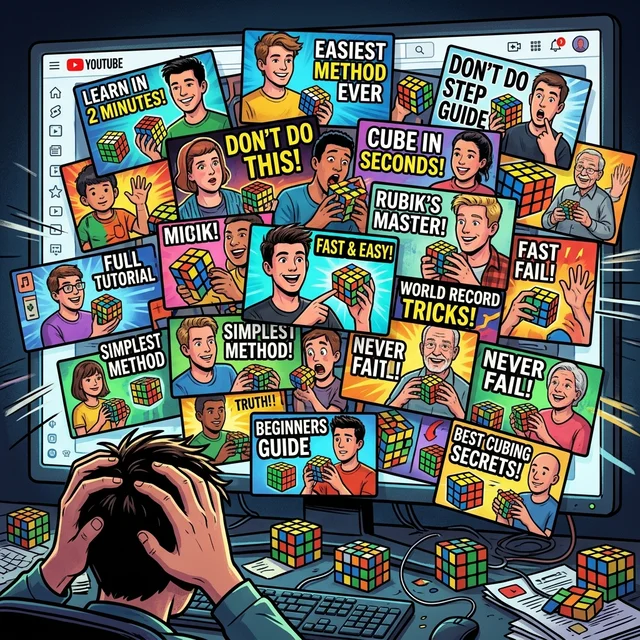 Above: Thousands of tutorials, all slightly different. For beginners, more choices often means more confusion.
What Changed: Why I Tried Again
After my third time giving up, I stayed away from the cube for a few years. What eventually brought me back was not a new tutorial. It was a shift in how I thought about the problem.
I realized that every time I had quit, I was blaming myself for a failure that was not mine. The notation was bad, not my brain. The tutorial couldn’t see my cube, not my fault. My cube might have been literally broken. The last layer is a known difficulty cliff that trips up everyone.
The problem was never intelligence. It was tooling.
What a good learning tool actually needs
Once I stopped looking for a better tutorial and started thinking about what I actually needed, the list was short:
- No notation. Show me which face to turn and which direction. Use arrows, colors, animations—anything but letters.
- Hands-free. Tell me what to do with audio so I never have to put the cube down.
- Know my cube. Scan my actual cube and track my exact state, so the instructions match what I’m holding.
- Tell me if it’s broken. Before I waste an hour, check if my cube is even solvable.
- One step at a time. Don’t dump a list of moves. Show me one move, let me do it, then show me the next.
That list is what led me to CubeUnstuck.
The Difference Between a Tutorial and a Teacher
A tutorial is a recording. It was made once, for a generic audience, and it plays the same way for everyone. It cannot see your cube. It cannot hear your confusion. It cannot tell you that the reason the last step isn’t working is that your cube has a twisted corner.
A teacher adapts. A teacher sees where you are and tells you what to do next.
The CubeUnstuck Digital Tutor is the closest thing to a real teacher for the Rubik’s Cube. Here is how it addresses each of the five quit-points:
Notation Wall → CubeUnstuck doesn’t use letter notation. Every move is shown with a curved trajectory arrow (showing where the piece will go) and a glowing rotation halo (showing which face to turn and in which direction). You watch, you do.
Last Layer Cliff → The app uses what it calls the “Sandwich” method: Observation (it highlights the relevant pieces and explains what to look for), Action (it animates the move), Confirmation (it shows the result and explains why it worked). You’re not memorizing in the dark—you’re learning with context.
Hands Problem → Every step includes voice narration. You listen to the instruction, turn the face, and the app advances automatically. Your hands never leave the cube.
Broken Cube Trap → Before the solve even begins, CubeUnstuck scans your cube through the webcam and runs a full mathematical diagnostic. If it detects a twisted corner, a flipped edge, or swapped pieces, it tells you exactly what’s wrong and how to fix it physically. Five seconds of scanning saves hours of frustration.
Tutorial Overload → There’s one method, one interface, and it’s synced to your actual cube. No searching for the right video. No conflicting advice. Just the next step.
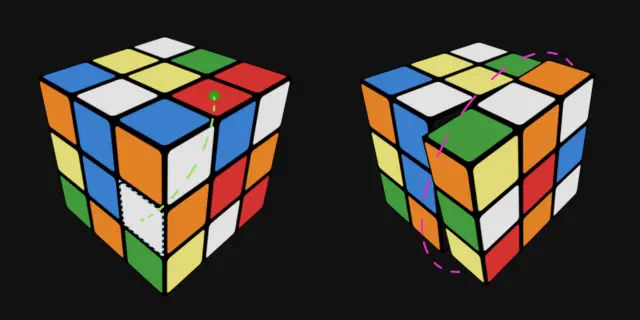 Above: Instead of notation, CubeUnstuck shows trajectory arrows and rotation halos. The user watches and turns — no translation step needed.
You Were Closer Than You Think
Here is the thing that surprised me most when I finally solved the cube: it was not nearly as far away as I thought.
All those years of “giving up,” I was never more than a few hours of guided practice from a completed solve. The knowledge gap between “hopelessly stuck” and “I can solve this” is small. What makes it feel enormous is the friction—the notation, the hands problem, the broken cubes, the conflicting tutorials.
Remove the friction, and the puzzle becomes what it was always supposed to be: satisfying, logical, and genuinely fun.
If you are sitting on five, ten, or twenty years of failed attempts, you are not bad at puzzles. You were using the wrong tools. The cube did not beat you. The learning method did.