
You bought a Rubik’s Cube. Maybe on impulse, maybe because your kid asked for help, maybe because it has been sitting on a shelf for years staring at you. Either way, you are now holding a scrambled puzzle with 43 quintillion possible arrangements and one burning question:
How long is this actually going to take?
The short answer: less time than you think, if you stop trying to figure it out alone. The long answer is more interesting.
The Honest Timeline (No Hype)
Let’s cut through the YouTube clickbait. Nobody learns the Rubik’s Cube “in 10 minutes.” Here is what a realistic learning curve actually looks like for a complete beginner:
Days 1–2: Your First Solve (1–3 Hours)
Your very first completed solve, following a tutorial step by step, typically takes 1 to 3 hours. This includes the time you spend pausing, rewinding, getting confused, and starting over at least once.
This is completely normal. If it helps, consider this: Erno Rubik, the person who literally invented the puzzle, needed an entire month to solve it for the first time. And he had zero tutorials, zero apps, and zero YouTube videos. He was completely on his own.
You are already faster than the inventor.
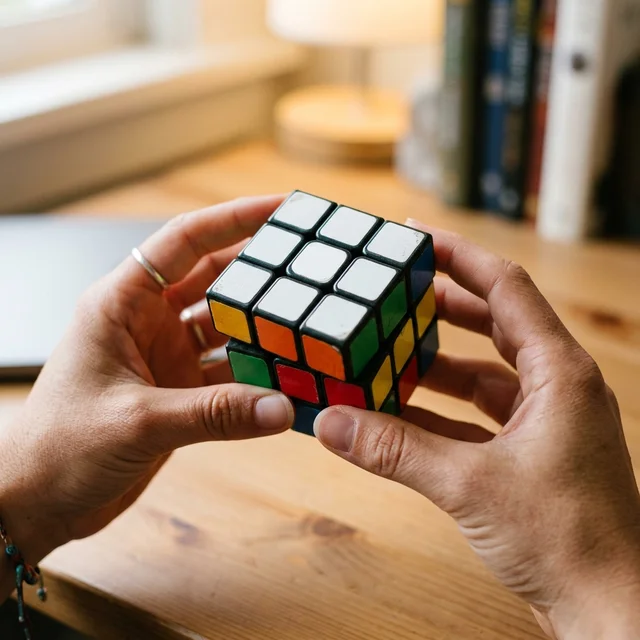 Above: The first layer is where most beginners feel a spark of confidence. From here, the puzzle gets more structured—and more rewarding.
Days 3–7: Solving Without Peeking
After your first successful solve, the next milestone is doing it from memory. Most people need 3 to 7 days of casual practice (roughly 20–30 minutes per day) before they can solve the cube without checking a guide.
At this stage, you are not fast. A typical beginner solve takes 5 to 10 minutes. That is perfectly fine. You are building muscle memory, and your fingers are learning the patterns even when your brain feels lost.
Weeks 2–4: Getting Comfortable (Under 3 Minutes)
With consistent daily practice, most beginners reach a 2- to 3-minute average within a few weeks. The cube stops feeling like a puzzle you are solving and starts feeling like a routine you are performing.
This is the point where roughly 5.8% of the world’s population lives. According to Rubik’s own estimates, fewer than 6 out of every 100 people who have touched a Rubik’s Cube can actually solve one. If you reach this stage, you are already in a very small club.
Where Everyone Gets Stuck
Learning the Rubik’s Cube is not a smooth, linear process. There are specific moments where almost everyone hits a wall. Knowing about them in advance makes them far less frustrating.
The Last Layer Wall
The first two layers of the cube are somewhat intuitive. You can look at a piece, figure out where it needs to go, and work out how to get it there with a bit of logic.
Then you reach the last layer, and everything changes.
The last layer requires you to memorize specific sequences of moves (algorithms) and execute them without fully understanding why they work. This is where the beginner method shifts from “thinking” to “trusting the process.” It is also where most people quit.
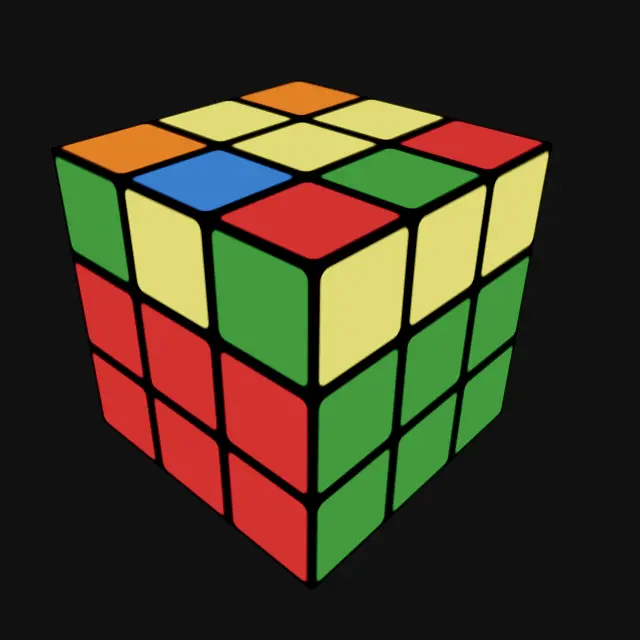 Above: Two layers done, but the final layer is where logic alone stops working. This is the most common quit point for beginners.
The Notation Barrier
Most tutorials teach you the Rubik’s Cube using letter-based notation: R means turn the right face clockwise, U’ means turn the top face counterclockwise, F2 means turn the front face 180 degrees.
For many beginners, this notation feels like learning a foreign language on top of an already difficult puzzle. It is one more thing to decode while your hands are already full (literally).
The “Broken Cube” Trap
Here is something almost no tutorial warns you about: your cube might be physically unsolvable.
If the cube was ever dropped, taken apart, or aggressively turned, a corner piece can twist in its socket or an edge can pop out and go back in wrong. When this happens, no algorithm in the world will solve it. But you don’t know that. You just think you are doing something wrong.
This is one of the most demoralizing experiences for a beginner—spending hours on the last step, convinced you are making a mistake, when the puzzle itself is broken.
What Actually Speeds Up the Process
Not all learning methods are equal. Based on what frustrates beginners the most, here is what genuinely makes a difference:
1. Skip the Notation (Use Visuals Instead)
If letter-based notation is slowing you down, you don’t have to use it. Visual guides that show you which face to turn and in which direction with arrows or animations let you follow along without decoding anything.
This is exactly how the CubeUnstuck Digital Tutor works. Instead of telling you “R U R’ U’,” it shows a curved arrow tracing the path of the piece that is about to move, followed by a glowing ring around the exact face you need to turn. You watch, you do. No translation step.
2. Keep Your Hands on the Cube
One of the biggest time sinks in learning is the constant cycle of: pick up the cube, try a move, put it down, check the tutorial, pick up the cube again, lose your place, start over.
Any method that lets you keep your hands on the cube while receiving instructions—whether that is audio narration, a voice assistant, or a hands-free screen guide—will dramatically reduce the back-and-forth.
3. Check If Your Cube Is Solvable Before You Start
If you have any suspicion that your cube might have been dropped, taken apart, or messed with, scan it first. A quick diagnostic check can save you hours of frustration on a puzzle that is physically impossible to solve.
The CubeUnstuck app runs a full mathematical diagnostic on your cube before you even begin solving. If it detects a twisted corner or a swapped edge, it tells you exactly which piece is broken and how to physically fix it. Five seconds of scanning can save an entire evening of confusion.
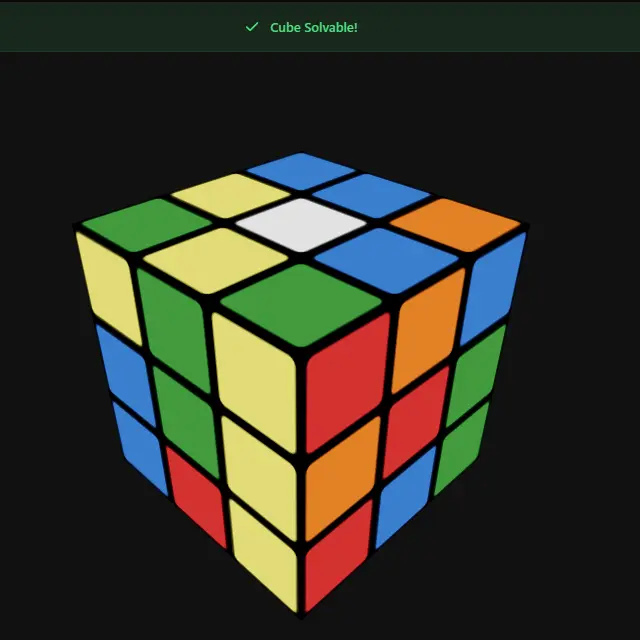 Above: A quick scan confirms your cube is mathematically solvable before you invest time in the solve. No more wasted hours on a broken puzzle.
A Realistic Expectation Table
Here is a no-nonsense summary of what to expect at each stage:
| Milestone | Typical Time | What It Feels Like |
|---|---|---|
| First solved cube (with a guide) | 1–3 hours | Confusing but exciting |
| Solving from memory | 3–7 days | Shaky, lots of pausing |
| Consistent sub-5-minute solves | 1–2 weeks | Starting to feel natural |
| Consistent sub-3-minute solves | 2–4 weeks | ”I can actually do this” |
| Confident enough to solve in front of someone | 4–6 weeks | Genuine pride |
These numbers assume casual daily practice of 20–30 minutes. If you binge-practice for a full afternoon, you can compress the early stages significantly.
You Are Not Too Old, Too Slow, or Too “Bad at Puzzles”
Let’s address the elephant in the room.
A lot of adults feel embarrassed that they can’t solve a toy designed for children. This feeling is based on a myth. The Rubik’s Cube was not designed for children. It was created by a Hungarian architecture professor to demonstrate three-dimensional geometry to his university students. It is a legitimate mathematical object with 43 quintillion configurations.
The inventor himself—a grown man with a background in spatial reasoning—needed a month to figure it out. The very first person to ever solve a Rubik’s Cube was not a child prodigy. It was a confused professor sitting alone in his Budapest apartment, turning faces for weeks until something finally clicked.
If you have spent years thinking you are “not smart enough” for this puzzle, you have been measuring yourself against an impossible standard. Nobody solves the Rubik’s Cube through raw intelligence. Everyone uses a method. The only question is whether your method is working for you.
Start With a Teacher, Not a Tutorial
The difference between a tutorial and a teacher is that a tutorial shows you what to do. A teacher sees where you are and tells you what to do next.
CubeUnstuck is a digital teacher for the Rubik’s Cube. It scans your physical cube through your webcam, builds a synchronized 3D model on your screen, and walks you through each step with visual arrows, animated highlights, and voice guidance. If you make a mistake, it adapts. If your cube is broken, it diagnoses the problem before you waste time.
You don’t need to memorize notation. You don’t need to pause and rewind a video. You don’t need to put the cube down.
You just need to start.