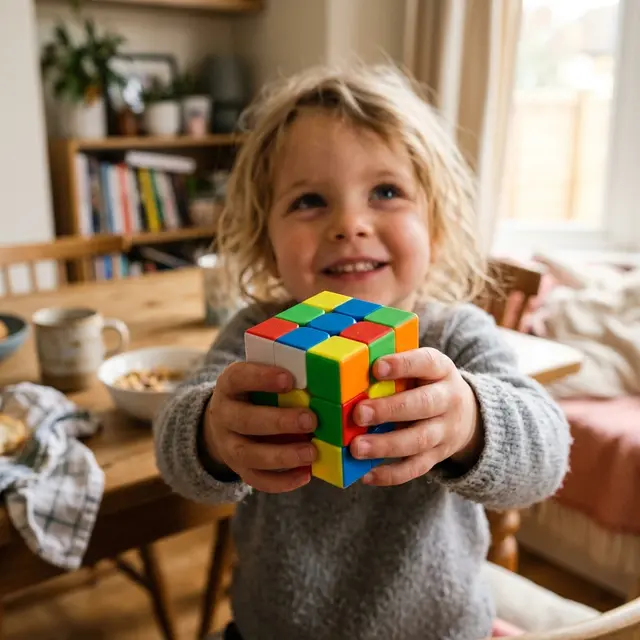
Your kid hands you a Rubik’s Cube. “Can you fix this?”
You look at it. The colors are everywhere. You have no idea how to solve it, but you are a parent, so you say, “Sure, let me try.”
Forty-five minutes later, you are sitting at the kitchen table, one YouTube tutorial deep, two layers done, and the last layer is not cooperating. You run the algorithm again. Same result. You run it again. Same result. Your child has moved on to something else. You have not.
You are not bad at this. The cube is almost certainly broken.
The Scenario Every Parent Knows
It usually goes like this:
- Child receives a Rubik’s Cube as a gift (birthday, school prize, impulse buy).
- Child scrambles it enthusiastically within 30 seconds.
- Child hands it to parent to “fix.”
- Parent cannot fix it.
- Cube goes in a drawer.
Sometimes there is a step 2.5: the cube gets dropped, pieces pop out, and the child pushes them back in. Sometimes a curious kid takes the whole thing apart and reassembles it “correctly” — all the right colors in the right places, but with the internal piece orientations scrambled.
In both cases, the cube looks perfectly normal from the outside. Every piece is present. Every sticker is intact. But inside, it is in one of the 11 mathematically impossible states that no sequence of moves can solve.
 Above: The moment every parent dreads. “Can you fix this?” The answer might not be about skill — the cube itself might be broken.
Why Kids’ Cubes Break So Often
Children between the ages of about 6 and 10 are the perfect age to be interested in a Rubik’s Cube, and also the perfect age to accidentally break one. Here is why.
Rough turning pops pieces out
Kids turn aggressively. They use force where finesse is needed. Modern speed cubes are designed to be loose for fast turning, which means an enthusiastic child can pop an edge piece right out of its socket with a particularly vigorous twist. The piece goes back in easily — but if it goes in at the wrong angle, the cube is now unsolvable.
Drops happen constantly
A Rubik’s Cube that hits a hard floor from table height will often pop one or more pieces loose. The child (or parent) pushes them back in. Everything looks fine. But here is the math: if even a single piece is reinserted with the wrong orientation, the puzzle becomes impossible to solve.
A randomly reassembled Rubik’s Cube has only a 1-in-12 chance (about 8%) of being in a solvable state. Those odds are terrible. If your child’s cube was ever dropped and pieces came out, the probability that it ended up solvable is very low.
Kids take them apart on purpose
Many children, once they realize the cube is made of individual pieces, take the whole thing apart to see how it works. This is completely natural curiosity. The problem comes when they reassemble it.
A Rubik’s Cube has 8 corner pieces and 12 edge pieces. Each corner can sit in three different orientations, and each edge in two. When a child puts the cube back together by matching visible colors, they get the pieces in the right places — but almost never in the correct internal orientations.
The result is a cube that looks solvable but isn’t.
Center caps get swapped
Some cubes have removable colored center caps (the single-color squares at the center of each face). Under these caps are the screws that hold the cube together. If a child removes these caps — which is easy to do with a fingernail — and puts them back in the wrong order, the cube’s entire color scheme shifts. Two edges will now appear permanently swapped, and no algorithm will fix it.
How to Tell If the Cube Is Broken
As a parent who probably doesn’t have deep Rubik’s Cube experience, you might wonder: how do I know whether the cube is broken or I am just doing something wrong?
Here are the telltale signs:
The “endless loop” symptom
You follow a tutorial, get through the first two layers fine, reach the last layer, run the final algorithm, and… the same pieces keep cycling. You repeat the algorithm. Same result. And again. Same result. The cube never resolves.
This is the single most common symptom of an impossible state. The algorithm works perfectly — it just cannot fix a problem that requires physical intervention, not more face turns.
The “one stubborn piece” symptom
Everything on the cube is solved — except one corner that is rotated in place, or one edge that appears flipped. No matter what you try, that one piece will not cooperate.
This is almost always a twisted corner or a flipped edge. Both are physical defects that cannot be fixed with normal moves.
The “almost there but not quite” symptom
Two pieces appear to have swapped positions. Everything else is perfectly solved, but these two are in each other’s spot. You try different last-layer algorithms. None of them fix just a two-piece swap.
This is a parity error, typically caused by center caps being in the wrong order.
 Above: Everything solved except one stubborn corner. This is not a skill issue — the piece is physically twisted in its socket and needs to be manually corrected.
The Five-Minute Hero Fix
Here is the good news: once you know the cube is broken, fixing it is fast and does not require any cubing expertise.
Option 1: Scan It
The fastest way to diagnose and fix the problem is to scan the cube with your phone or laptop webcam using the CubeUnstuck Digital Tutor.
The app reads all six faces of the cube and runs a full mathematical diagnostic. Within seconds, it tells you one of two things:
- “Your cube is solvable.” Great — proceed to the guided solve.
- “Defect detected.” The app identifies the exact problem (twisted corner at position X, flipped edge between colors Y and Z, center cap misalignment) and shows you how to physically fix it.
No Rubik’s Cube knowledge required. No algorithms. Just scan, fix, and solve.
This is the “Parent Hero” moment: your kid has been struggling with a broken cube for days, you pick it up, scan it in 30 seconds, pop one piece back into place, and hand it back fixed. Five minutes from frustration to hero.
Option 2: Fix It Manually
If you prefer to fix it by hand, here are the three most common repairs:
Twisted corner: Grip the misaligned corner between your thumb, index finger, and middle finger. Twist it firmly 120 degrees clockwise or counterclockwise until it clicks into the correct orientation. No tools needed.
Flipped edge: Turn the top layer 45 degrees. Gently pry the flipped edge piece out with your thumbnail or a flat tool. Flip it 180 degrees and press it back in. On tighter cubes, you may need to slightly loosen the center screw first.
Swapped center caps: Remove the four side center caps from the middle layer (not the top or bottom). Rotate them one position around the cube (move Green to where Orange was, Orange to Blue, Blue to Red, Red to Green). Press them back in.
For detailed walkthroughs of each fix, see:
- Twisted Corner on a Rubik’s Cube: Why It’s Unsolvable
- Two Swapped Edges on a Rubik’s Cube: The Real Fix
- Why Does My Rubik’s Cube Have One Wrong Piece?
After the Fix: Solving It Together
Once the cube is confirmed solvable, you have an opportunity. Instead of just handing it back scrambled, solve it with your kid.
The CubeUnstuck Digital Tutor is designed for exactly this scenario. The app guides both of you through the beginner method step by step with:
- Voice narration so neither of you needs to read a screen while turning the cube
- Visual arrows and highlights instead of confusing letter notation
- A synchronized 3D model of your exact cube, so you can both see which piece moves next
You don’t need to know how to solve a Rubik’s Cube. The app knows. You and your child just follow along, one step at a time.
Many kids in the 7-to-10 age range can follow the guided solve with minimal adult help. For younger kids (6 and under), you may want to take the lead on the turns while they watch the screen and call out what the app says to do. Either way, it becomes a shared activity instead of a solo frustration.
 Above: Once the cube is fixed, solving it together is a five-minute bonding moment — not a homework assignment.
Preventing Future Breaks
A few simple habits can keep your child’s cube solvable:
-
Start from solved. When your kid is done playing, encourage them to solve the cube (with CubeUnstuck’s help if needed) before putting it away. A cube that is always scrambled from a solved state is always solvable.
-
Don’t force turns. Teach your child that if a face won’t turn, they should realign the layers first (make sure everything is squared up) rather than forcing it. Forced turns are the number one cause of popped pieces.
-
Scan after drops. If the cube hits the floor and anything pops out, scan it before continuing. Five seconds of prevention saves hours of frustration.
-
Keep center caps on. If your child has discovered the center caps can come off, gently explain that moving them around will make the cube impossible to solve. Or, a small dab of clear glue under each cap can keep curious fingers from rearranging them.
You Are Not Failing Your Kid
If you have spent an evening unable to solve your child’s Rubik’s Cube, you are in the company of hundreds of millions of adults worldwide. Fewer than 6% of people who have touched a Rubik’s Cube can solve one. And many of those who cannot were working with broken cubes without knowing it.
The cube was not designed as a children’s toy. It was created by a Hungarian university professor to teach architecture students about three-dimensional spatial relationships. The inventor himself needed a month to solve it. You are not failing your kid by not being able to solve it in an evening.
What you can do is check whether the puzzle is fair before anyone spends time on it. Scan it, fix it if needed, and then solve it together. That is the parent hero move.