
You have been working on this Rubik’s Cube for an hour. Maybe two. The first layer is done. The second layer is done. The last layer is almost there. But there is one piece—just one single piece—that will not cooperate. You run the algorithm again. And again. Nothing changes. The same stubborn corner or edge sits there, mocking you.
You start to wonder: Am I doing something wrong?
Probably not. There is a very good chance your cube is physically, mathematically broken—and no amount of skill or patience will fix it.
You Did Not Fail. The Cube Did.
Here is something most tutorials never mention: a Rubik’s Cube can end up in a state that is impossible to solve. Not “very hard to solve.” Not “you need a more advanced algorithm.” Literally impossible. No sequence of face turns, no matter how clever, will ever reach a solved position from that state.
This is not a rare edge case. There are 12 distinct “universes” a Rubik’s Cube can exist in, based on how its pieces are arranged internally. Only one of those 12 is solvable by turning the faces. The other 11 look perfectly normal on the outside—the colors are all there, the stickers are fine—but the internal arrangement of pieces makes a solution mathematically unreachable.
If you have ever taken your cube apart, or if it was dropped and pieces popped out and were pushed back in, there is only a 1-in-12 chance (about 8.3%) that the cube ended up in the solvable universe.
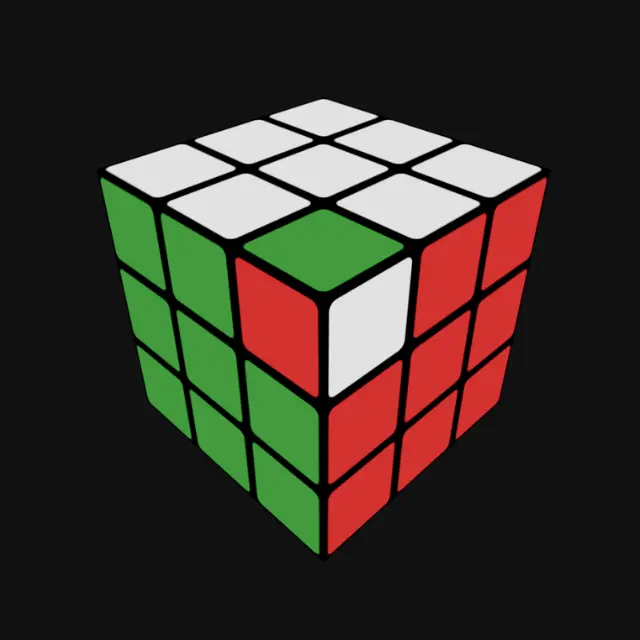 Above: Everything is solved—except this one corner. No algorithm will fix it. The piece itself needs to be physically corrected.
The Three Usual Suspects
That “one wrong piece” feeling almost always comes down to one of three specific hardware defects. Here is how to tell which one you have.
1. A Twisted Corner
What you see: The entire cube is solved, but one single corner piece is rotated in its socket. The corner is in the right place, but its colors are facing the wrong directions. It looks like someone grabbed it and twisted it.
Why it happens: Corner pieces on a Rubik’s Cube can be physically rotated without removing them, especially on modern speed cubes with looser tensions. A single firm twist during aggressive turning—or a kid gripping the puzzle too hard—can silently rotate a corner by 120 degrees. You will not notice it happened until you reach the very last step of the solve.
The cruel part: You can solve the entire rest of the cube normally. The first layer, the second layer, even most of the last layer will go in without any trouble. The defect only reveals itself at the absolute final step, when you find yourself running the last algorithm in an endless loop that never resolves.
The fix: Grip the twisted corner firmly between your thumb, index finger, and middle finger, and physically twist it back. You need to rotate it exactly 120 degrees clockwise or counterclockwise until it clicks into alignment. That is it. No disassembly required.
For a full explanation with visual proof, see our detailed guide: Twisted Corner on a Rubik’s Cube: Why It’s Unsolvable.
2. A Flipped Edge
What you see: Everything is solved except one edge piece that appears to be flipped in place. The piece is in the correct position, but its two colors are swapped—as if someone pulled it out, rotated it 180 degrees, and pushed it back in.
Why it happens: This almost always means the cube was taken apart (or pieces popped out after a drop) and an edge was reinserted in the wrong orientation. Unlike a twisted corner, a flipped edge is very hard to cause through normal turning.
The fix: Turn the top layer 45 degrees, gently pry the flipped edge out, flip it around, and push it back in. You may need to apply moderate pressure. On tighter cubes, you can loosen the center screw slightly to make removal easier.
3. Two Swapped Pieces
What you see: The cube is almost solved, but two pieces appear to have traded places. Maybe two edges are swapped, or two corners are in each other’s spots. Everything else is correct.
Why it happens: This is the sneakiest defect. It usually comes from center caps being removed and replaced in the wrong order—something that can happen during cleaning, re-tensioning, or simply curious fingers exploring the cube. Since center pieces define which color belongs on which face, shifting them by 90 degrees invisibly redefines the entire color scheme, making it look like two pieces are “swapped” when really the reference frame has shifted.
The fix: You have two options:
- Swap the pieces physically: Turn the top layer 45 degrees, pry out the two incorrect pieces, swap their positions, and press them back in.
- Fix the centers: Remove the four side center caps from the middle layer and rotate them one position (e.g., move Green’s cap to where Orange’s was, Orange to Blue, Blue to Red, Red to Green). This restores the correct color scheme without touching any other pieces.
For the full breakdown, see: Two Swapped Edges on a Rubik’s Cube: The Real Fix.
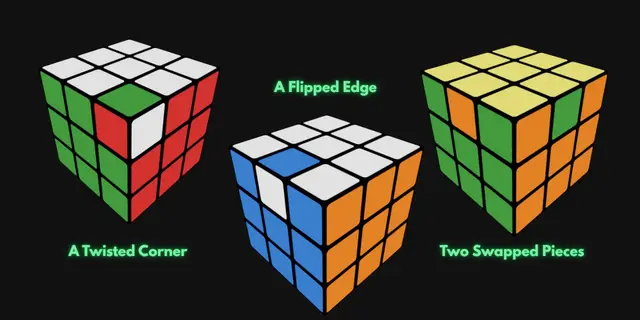 Above: The three hardware defects that make a Rubik’s Cube unsolvable—a twisted corner, a flipped edge, and two swapped pieces. All look almost solved, but none can be fixed with algorithms.
How Does This Happen in the First Place?
The most common scenarios, roughly in order of frequency:
-
The cube was dropped and pieces popped out. Especially on budget cubes, a hard impact can dislodge an edge or corner. If anyone pushed the pieces back in without checking orientation, the cube may now be in one of the 11 unsolvable states.
-
Someone took it apart and reassembled it. Kids do this. Adults do this. It seems harmless. But random reassembly has only an 8.3% chance of producing a solvable cube. That means 11 out of 12 randomly reassembled cubes are broken from the start.
-
Center caps were moved. Some people remove the center caps to clean the cube or adjust the tension screws underneath. If the cube was scrambled when the caps came off, it is nearly impossible to remember which cap goes where. One 90-degree error in center placement creates a permanent, invisible parity defect.
-
A corner was accidentally twisted during turning. This is especially common on newer speed cubes designed to be loose for faster turning. A firm, slightly off-angle turn can rotate a corner piece without the user noticing.
The Problem: You Don’t Know Which Defect You Have
Here is what makes this so frustrating for beginners. You are staring at your cube, something is clearly wrong, but you have no idea if it is:
- A twisted corner (fix: twist it back)
- A flipped edge (fix: pop it out and flip it)
- A swapped pair (fix: swap pieces or rotate centers)
- Or an actual mistake you made during the solve
All four of these situations look almost identical to a beginner. The cube is “nearly solved” and “one thing is off.” Without knowing the specific defect, you are left guessing—or worse, you assume you are the problem and start the entire solve over from scratch.
This is one of the most common reasons people give up on the Rubik’s Cube. Not because the puzzle is too hard, but because the puzzle is literally broken and they do not know it.
The Fastest Way to Diagnose the Problem
Before you invest time in solving your cube, you can find out in seconds whether it is solvable or broken.
The CubeUnstuck Digital Tutor includes a full diagnostic scanner. You hold your cube to your webcam, the app reads all six faces using adaptive computer vision, and then it runs a mathematical validation before the solve even begins.
If your cube has a twisted corner, the app identifies exactly which corner is wrong and which direction to twist it. If an edge is flipped, it tells you which one. If two pieces are swapped, it shows you the swap and explains how to fix it physically.
No guessing. No wasted hours. No self-doubt.
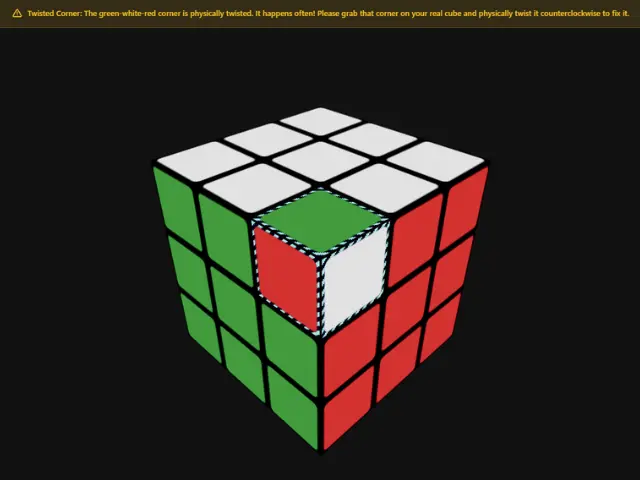 Above: The CubeUnstuck scanner detected a twisted corner before the user even started solving. Five seconds of scanning saved an evening of frustration.
When In Doubt, Scan First
If you have any reason to believe your cube might have been dropped, taken apart, aggressively turned, or played with by a child, scan it before you start solving. This one habit eliminates the single most demoralizing experience in learning the Rubik’s Cube: spending hours on a puzzle that was never solvable in the first place.