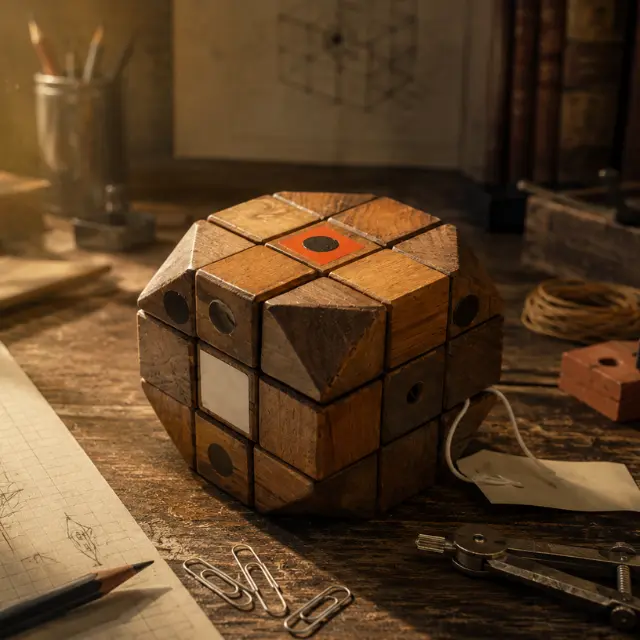
In the spring of 1974, in a small apartment in Budapest, a 29-year-old design lecturer was fiddling with blocks of wood.
He was not trying to invent a toy. He was not thinking about money, or fame, or the fact that 50 years later people would still be picking up his creation and getting stuck on the last layer. He was trying to solve a structural problem: how do you make a solid object whose individual parts can move independently without the whole thing falling apart?
His name was Erno Rubik. And the thing he built — out of wood, paper clips, rubber bands, and glue — would become the bestselling toy in human history.
A Puzzle That Was Not Supposed to Be a Puzzle
Rubik was teaching interior design at the Academy of Applied Arts and Crafts in Budapest. He wanted to help his students understand three-dimensional movement — how parts of a structure relate to each other in space. The concept was abstract, and he thought a physical model might make it click.
He spent months tinkering. The early models were rough: wooden blocks held together with elastic bands, paper, and adhesive. The challenge was mechanical — creating a structure where 26 individual pieces could rotate around a central axis without disconnecting. It sounds simple now. In 1974, it had never been done.
When he finally got it to work, he added colored stickers to each face so he could track how the pieces moved. Then he twisted it.
And then he could not twist it back.
“It was fiendishly difficult to find your way back,” Rubik later told Undark on this video. “And I was without any background for that, because I was the first who tried.”
It took him a full month — working alone in his apartment, without any method or guide — to return the cube to its original state. He was the first person to ever solve a Rubik’s Cube. That month-long struggle was both a world record and a world first.
He prefers to say he “discovered” the cube rather than invented it — as if it had always existed and was just waiting for someone to find it.
 Above: Erno Rubik, the Hungarian architect and inventor who created the Rubik’s Cube in 1974. He originally called it the “Buvos Kocka” — the Magic Cube. (Photo: fdecomite/Wikimedia Commons, CC BY 2.0)

From Budapest to the World
Hungary in 1974 was behind the Iron Curtain. It was a communist state with no particular tradition of toy manufacturing. Rubik filed a Hungarian patent for his “spatial logic toy” in January 1975, and the first small batches of the Magic Cube appeared in Budapest toy shops in late 1977.
For two years, the cube was a local curiosity — popular in Hungary but unknown to the rest of the world. That changed in February 1979, when businessman Tibor Laczi brought a Magic Cube to the Nuremberg Toy Fair in Germany. It caught the eye of Tom Kremer, founder of Seven Towns, a toy marketing company. Kremer recognized what he was looking at: a puzzle that could cross language barriers and appeal to anyone, anywhere.
Kremer brokered a deal with the Ideal Toy Company in September 1979. Ideal wanted a name they could trademark — “Magic Cube” was too generic. They considered “The Gordian Knot” and “Inca Gold” before settling on the obvious choice: Rubik’s Cube.
The cube made its international debut at toy fairs in London, Paris, Nuremberg, and New York in January and February 1980. The first export batches shipped from Hungary in May 1980, packaged in clear plastic cylinders, priced at $1.99.
Initial sales were modest. Then Ideal launched a $1.5 million television advertising campaign. What happened next was unlike anything the toy industry had seen.
The Craze
By 1981, the Rubik’s Cube was everywhere.
In March 1981, it landed on the cover of Scientific American, where Pulitzer-Prize winning scientist Douglas Hofstadter — author of “Godel, Escher, Bach” — called it “one of the most amazing things ever invented for teaching mathematical ideas.”
By June 1981, The Washington Post described it as “a puzzle that is moving like fast food right now.” By September, New Scientist noted that the cube had “captivated the attention of children of ages from 7 to 70 all over the world.”
Books on solving the cube flooded the market. At one point in 1981, three of the top ten bestselling books in the United States were about the Rubik’s Cube. The bestselling book of the entire year was James G. Nourse’s “The Simple Solution to Rubik’s Cube,” which sold over 6 million copies. A 12-year-old named Patrick Bossert wrote “You Can Do the Cube,” which sold 1.5 million copies — making him one of the youngest bestselling authors in publishing history.
The Museum of Modern Art in New York added a Rubik’s Cube to its permanent collection in 1981. A six-foot cube was displayed at the 1982 World’s Fair in Knoxville, Tennessee. In 1983, ABC Television produced an animated series called “Rubik, the Amazing Cube” — a show where a magical talking cube helped a group of kids solve mysteries. It was exactly as bizarre as it sounds.
Between 1980 and 1983, an estimated 200 million Rubik’s Cubes were sold worldwide. The cube entered the Oxford English Dictionary. The word “Rubikmania” appeared in a Time magazine cover story.
And then, almost as fast as it had arrived, the craze ended.
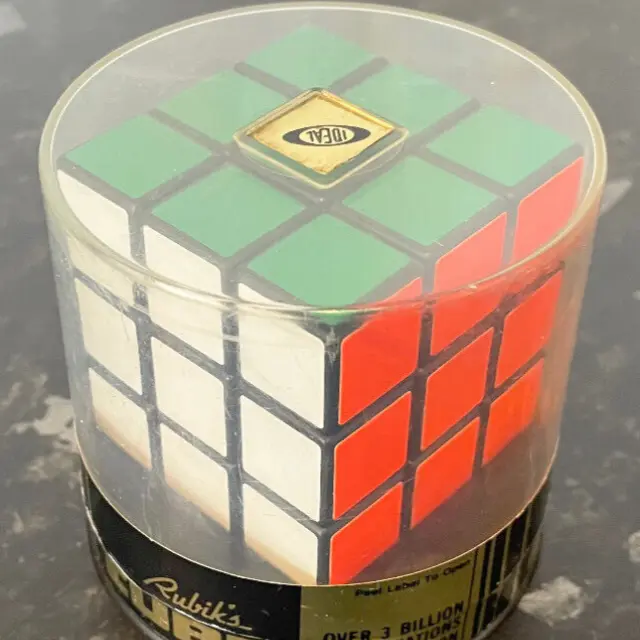 Above: An original 1980 Rubik’s Cube as sold by Ideal Toy Corporation. The first export batches shipped from Hungary in clear plastic cylinders. (Photo source: Wikimedia Commons — original 1980 cube, Made in Hungary)

The Crash and the Long Silence
By October 1982, The New York Times declared the craze over. “Street corner merchants hawk ‘ET’ paraphernalia now,” the paper reported, “and electronic video games have taken over toy store shelves.”
Sales plummeted. Knockoff cubes had flooded the market. The puzzle felt like a fad — something that belonged to 1981 the way pet rocks belonged to 1975. Ideal Toy Company, struggling financially, was eventually acquired. The cube stayed on shelves through the late 1980s and 1990s, but it was a background item — a piece of nostalgia, not a living phenomenon.
For nearly 20 years, the Rubik’s Cube was basically dormant.
The First Championship (And the Woman Who Changed Everything)
Before the crash, something happened that would shape the cube’s future. On June 5, 1982, the first Rubik’s Cube World Championship was held at the Vigado Concert Hall in Budapest. Nineteen competitors from around the world took part.
Minh Thai, a 16-year-old from the United States, won with a time of 22.95 seconds. He received a gold-plated Rubik’s Cube as his prize. By today’s standards, 22.95 seconds would not make the top 100,000 — but in 1982, it was remarkable.
Among the other competitors was a 29-year-old from Czechoslovakia named Jessica Fridrich. She finished tenth, with a time of 29.11 seconds. Her placing was unremarkable. What she did afterward was not.
Fridrich went on to develop and document the CFOP method — a solving system that broke the last layer into more manageable sub-steps using optimized algorithms. Her method, published freely on the early internet, became the foundation of modern speedcubing. The vast majority of competitive speedcubers today still use a method based on Fridrich’s work. She did not win the 1982 championship, but she arguably did more to shape the Rubik’s Cube community than anyone except Rubik himself.
The Internet Revival
The Rubik’s Cube’s second life began quietly in the early 2000s. Rubik’s original patent expired in 2000, which opened the door for new manufacturers — particularly in China — to produce smoother, faster, cheaper cubes. At the same time, the internet was creating something that did not exist during the 1980s craze: a global community of solvers.
In 2003, the first speedcubing world championship since 1982 was held in Toronto. The World Cube Association was founded in 2004 to organize competitions worldwide. YouTube, which launched in 2005, gave cubers a way to share tutorials, compete remotely, and showcase their skills to millions.
Sales doubled in the US between 2001 and 2003. The Boston Globe noted it was “becoming cool to own a Cube again.” By 2008, annual sales reached 15 million worldwide. By 2017, retail sales hit $250 million in a single year.
The world record, which was 22.95 seconds in 1982, has been shattered repeatedly. As of 2025, the fastest single solve is under 4 seconds. Competitions now include blindfolded solving, one-handed solving, and solving with feet (since discontinued as an official event, though it was real).
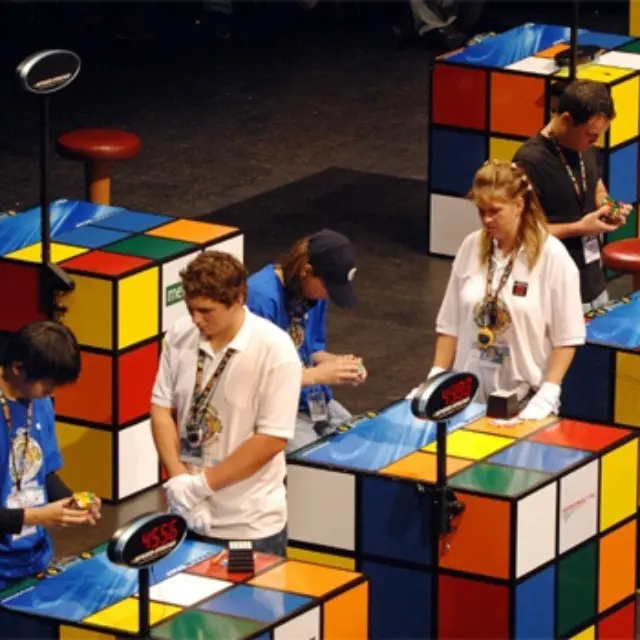 Above: A modern speedcubing competition. The World Cube Association now sanctions thousands of events annually across the globe. The world record has dropped from 22.95 seconds in 1982 to under 4 seconds today. (Photo: Wikimedia Commons — Rubik’s Cube competition)
500 Million and Counting
As of 2024, approximately 500 million Rubik’s Cubes have been sold worldwide. It is the bestselling toy of all time — ahead of Barbie, ahead of Hot Wheels, ahead of everything. The cube was inducted into the US National Toy Hall of Fame in 2014.
Rubik himself — now in his 80s — published a book in 2020 called “Cubed: The Puzzle of Us All,” reflecting on why a simple block of colored squares captivated the world. He describes himself as “a concrete and intuitive thinker” and “an amateur inventor.” He takes pride in his ability to self-teach, and bristles at the idea that those in authority are always in the best position to impart knowledge.
“That is one of its most mysterious qualities,” Rubik writes about his creation. “The end turns into new beginnings.”
Why This Matters If You Are Holding a Cube Right Now
Here is why this history is relevant if you are sitting there with a scrambled Rubik’s Cube in your hands, wondering if you will ever solve it.
The person who created this puzzle — the person who understood it better than anyone alive — took a full month to solve it. He had no tutorial. No app. No YouTube video. Just his hands, his brain, and a wooden block with colored stickers.
You are not expected to figure this out alone. Rubik did, because he had to. You do not have to. Fifty years of accumulated knowledge, methods, and tools exist specifically so that you can solve the cube without spending a month in a Budapest apartment.
That includes tools like CubeUnstuck, which takes Rubik’s original idea — understand the cube through hands-on experience — and gives you a guide that walks beside you, one move at a time. You scan your cube, and the app shows you exactly what to do, in the exact order, with visual cues and voice narration. No notation to decode. No algorithms to memorize. Just you and the cube, solving it the way Rubik would have wanted: by doing it.
The Rubik’s Cube has been around for half a century. It has survived a craze, a crash, a 20-year silence, and a full-scale revival. It is the most popular puzzle ever made, and it is still sitting on shelves — waiting for someone to pick it up and give it another try.
Maybe this time, with the right guide, you will actually finish it.