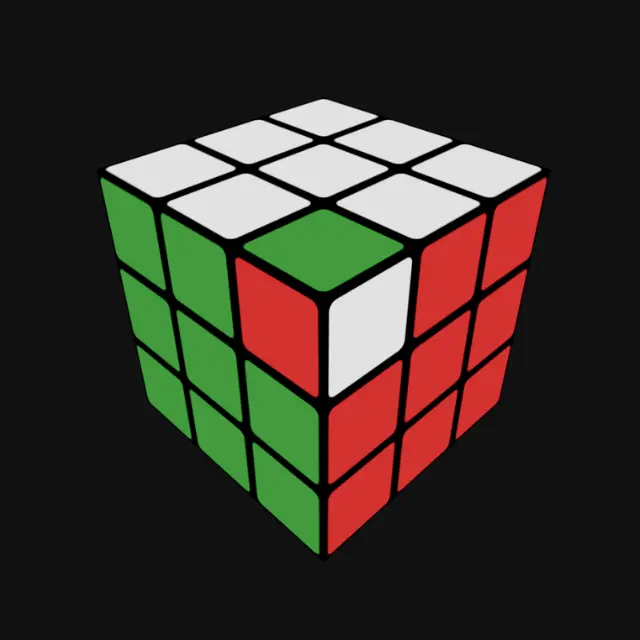
If you have spent hours trying to finish the last layer of your Rubik’s Cube, only to find that one single corner piece is facing the wrong way, you are not crazy. If your Rubik’s Cube has one corner turned the wrong way and you can’t solve the last layer, you probably have a twisted corner defect.
You did not mess up your algorithm. You did not skip a step. Your cube is physically, mathematically broken, which makes the Rubik’s cube impossible to solve.
Before you give up and throw the puzzle in a drawer, read this. A single twisted corner is one of the most common hardware issues in cubing. Here is exactly why it happens, the mathematical reason you can’t solve it, and how to safely force it back to normal.
⚡ TL;DR: Can you solve a Rubik’s Cube with exactly one twisted corner?
No. A single twisted corner is a “parity error.” It is mathematically impossible to solve with normal twists and turns. It usually happens because the physical plastic piece accidentally caught on your finger and rotated in its socket while you were turning a face.
The Fix: Stop trying to solve it with algorithms. Simply grab the offending corner piece with your thumb and index finger and physically twist it back into place. If you aren’t sure which corner is wrong, use a smart scanner like CubeUnstuck to diagnose the exact piece.
What Is a Twisted Corner?
In super plain language, a twisted corner is simply a corner sticker block that has turned in place so the colors don’t match the rest of the puzzle. It rotates inside its own socket without actually moving to a different location.
Imagine you are solving the yellow face on top of your cube. Everything lines up perfectly, but one corner has yellow facing you instead of pointing up. No matter what combination of moves you try, that one piece refuses to orient itself correctly.
Why Your Cube Looks Solved But One Corner Is Wrong
For beginners, a Rubik’s Cube feels like a random scramble of blocks. In reality, it operates on strict mathematical laws.
One of these laws is the Orientation Rule (often called the Modulo-3 or “Mod-3” rule). Think of it like a balancing scale. If a legal turn causes one corner to twist clockwise (+1), it must cause another corner to twist counter-clockwise (-1) to keep the puzzle mathematically balanced at zero.
Because corners have 3 colors, their twists must always add up to a multiple of 3. A single twisted corner leaves the math unbalanced. Therefore, no sequence of legal, normal turns will ever be able to target just that one corner. (Don’t worry—you do not need to understand this math to fix it; just follow the physical steps below!)
How Twisted Corners Happen in Real Life
If algorithms didn’t cause this, what did? Almost always, it comes down to physical force:
- Aggressive Turning (Corner-Cutting): Modern speed cubes are designed to be flexible. If you try to turn the right face before the top face is fully aligned, the corner piece can snag against your finger or another piece and physically “snap” into a twisted position. This is incredibly common for beginners!
- Dropping the Cube: A hard fall to the floor can jar a loose corner out of alignment.
- Mis-assembly: If your cube popped apart or your kid took the pieces out, and you shoved them back together randomly, there is only a 1 in 12 chance that the cube was reassembled in a solvable state.
How to Tell If Your Cube Has a Twisted Corner
In traditional solving, you usually don’t discover a twisted corner until the very last step. Advanced solvers use the “Rule of Three”—they count the orientation of the corners on the last layer. If the number of incorrectly facing corners isn’t divisible by 3, they know the cube is broken.
But you don’t need to do complex math or wait until the end of the solve to find out your cube is broken.
The Easy Way: Let the App Diagnose It If you suspect your cube is unsolvable, use the CubeUnstuck digital twin scanner. It maps your real-life cube to a 3D model and instantly flags mathematical impossibilities.
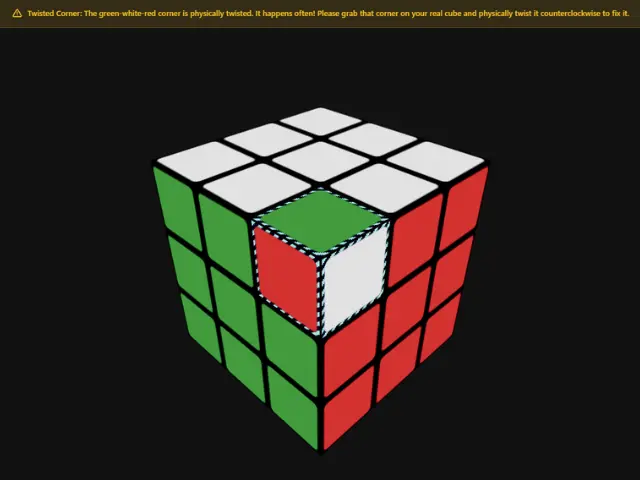 Above: The CubeUnstuck diagnostic tool identifying a mathematically impossible corner twist. Click here to open this exact broken cube in the app and see how it detects the error.
If you scan a cube with a twisted corner, the app immediately halts your frustration, highlights the exact broken piece on your screen, and tells you the physical direction to twist it to save your solve.
How to Fix It Safely
Because this is a hardware problem, you need a hardware solution. Here is how to fix it:
- The Beginner Fix (The Twist): Just grip the incorrect corner piece firmly with your thumb and index finger, and twist it in place until the colors align with the surrounding centers. Most modern cubes allow for this easily.
- The Pop-Out Method: If your cube is older or the tension is too tight, trying to twist it might snap the plastic core. Instead, turn the top face 45 degrees, wedge your thumb under the corner piece, and firmly pop it out of the cube. Rotate it to the correct colors, and snap it back in.
FAQ: Can I Twist Any Corner? Is That Cheating?
Can I just twist a different corner to fix it? Technically, yes. In pure cube theory, if one corner is accidentally twisted clockwise, you could purposely twist a completely different corner counter-clockwise to satisfy the “Mod-3 Rule” and make the puzzle solvable again. However, doing this means you will still have to use algorithms to solve the rest of the cube. It is much easier to just twist the specific corner that broke in the first place!
Is twisting a piece cheating? Absolutely not. In fact, under official World Cube Association (WCA) competition rules, if a cuber accidentally twists a corner during a fast solve, they are legally allowed to physically twist it back. It is classified as “repairing a puzzle defect.”
Stop blaming yourself for a puzzle that is physically fighting back. Use the CubeUnstuck scanner to check your cube’s health, physically twist that stubborn corner back into place, and get back to solving!