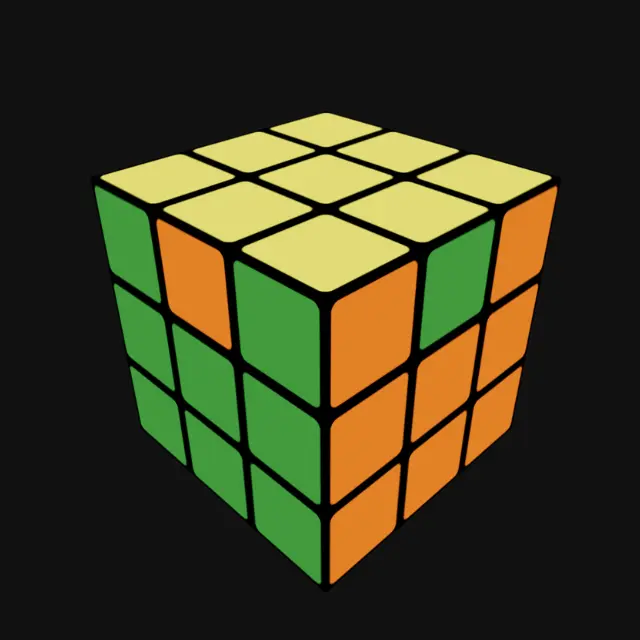
If you’ve been staring at your Rubik’s Cube for hours trying to fix exactly two swapped edge pieces while the rest of the cube is perfectly solved, take a deep breath. Stop watching algorithm tutorials. Stop thinking you aren’t smart enough to figure it out.
It is mathematically impossible to solve.
In the cubing world, this is known as a parity error. On a standard 3x3 Rubik’s Cube, a “pure” 2-edge swap cannot happen through normal turning. If you are looking at this case right now, human intervention caused it.
Here is exactly why your cube is unsolvable, the visual proof of how it happens, and the real-world fixes to get your cube back to normal.
⚡ TL;DR: Can you solve a 3x3 Rubik’s Cube with only 2 swapped edges?
No. A pure 2-edge swap is a “parity error” and is mathematically impossible to solve with normal moves. It is caused by hardware issues—usually because center caps were removed and put back incorrectly, or edge pieces were popped out and reinserted wrong.
The Fix: You must physically pop the edges out and swap them, or shift your four side center caps by one step in a circle (e.g., move the Green cap to Orange’s spot, Orange to Blue’s spot, etc.). If you aren’t sure which to do, use a smart scanner like CubeUnstuck to instantly diagnose exactly which pieces are swapped and how to fix them.
The Myth: “Any Piece Can Go Anywhere”
A common misconception for beginners is that a Rubik’s Cube is just a cluster of free-floating blocks, meaning any colored piece can end up in any spot.
But think about how the puzzle actually mechanically turns. Every time you rotate a face, you are moving exactly four edges and four corners at the exact same time. Because pieces travel in these locked orbits, every move has a mathematical chain reaction. You can never move just two pieces without moving others. To swap only two edges while leaving the rest of the puzzle perfectly solved breaks the physical laws of the cube.
Why Do I Have Two Swapped Edges? (The Root Causes)
According to countless frustrated posts on Reddit and cubing forums, this impossible state almost always comes down to a hardware mix-up.
- The Center Caps Were Moved: Did you (or your kid) pop the colored center caps off to clean the cube or adjust the screws? If they were put back on in the wrong order, the cube’s fundamental color scheme is now broken, creating the illusion of a 2-edge swap.
- Pieces Were Popped and Reinserted: If the cube was dropped, shattered, or forcefully taken apart, and someone shoved the pieces back in randomly, there is a 50% chance they created an impossible state.
- Factory Mis-assembly: Yes, sometimes cubes come assembled incorrectly right out of the box!
- Misdiagnosis: Sometimes, it’s not actually a 2-edge swap. You might have placed a corner-edge pair relative to the wrong center color, or there is a hidden twisted corner you haven’t noticed.
The Visual Proof: How Centers and Edges Interact
To understand why this happens, let’s look at the CubeUnstuck digital twin diagnostic tool. One of the best features of our app is its Validation & Diagnosis check—it will instantly tell you if your cube is physically unsolvable so you don’t waste time trying.
Here are three interactive 3D examples from our app that explain the 2-edge swap mystery:
1. The Classic Unsolvable Case (Only 2 Edges Swapped)
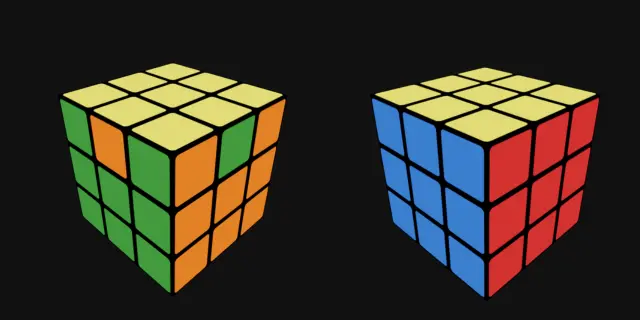 Above: A digital scan showing exactly two adjacent edges swapped. The app instantly flags this as mathematically impossible—no algorithm can fix this.
Interactive 3D View: Click here to view this cube in CubeUnstuck
The Verdict: Unsolvable. If you look at this digital twin, exactly two adjacent edges are swapped. The app immediately flags this as an impossible state. No combination of twists or turns will ever fix this.
2. The Shifted Centers
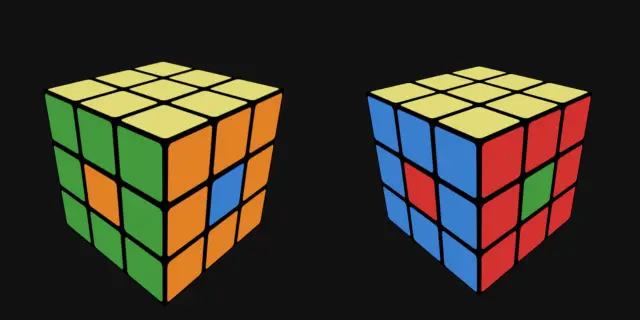 Above: The edges here are actually correct, but the center caps have been put back in the wrong order. This also creates an unsolvable puzzle.
Interactive 3D View: Click here to view this cube in CubeUnstuck
The Verdict: Unsolvable. Here, the edges are actually fine, but the center pieces have been moved one step out of their correct color scheme. Because the centers dictate the skeleton of the puzzle, the app recognizes this is also impossible to solve through turning.
3. Two Wrongs Make a Right (Swapped Edges + Shifted Centers)
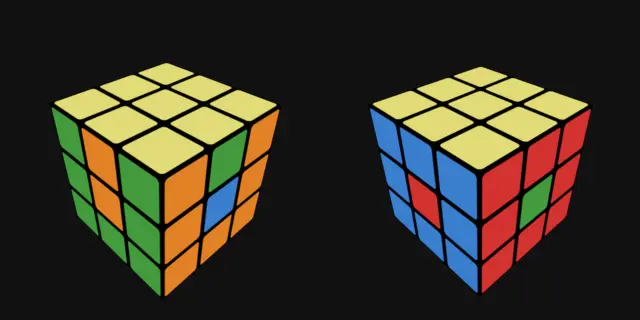 Above: The “Aha!” moment. By combining the swapped edges with shifted centers, the puzzle becomes mathematically solvable again. This proves how often hardware mix-ups cause this issue.
Interactive 3D View: Click here to view this cube in CubeUnstuck
The Verdict: Solvable! This is the “Aha!” moment. If you combine Case 1 (swapped edges) with Case 2 (shifted centers), the cube suddenly becomes legally solvable again. This proves that what looks like a 2-edge swap is incredibly often just misaligned center caps underneath!
How to Fix the 2-Edge Swap (Real Solutions)
Since you can’t solve it with algorithms, you have to use your hands. Here are the two most common ways to fix it:
Solution A: Pop and Swap the Edges (The “Parent Hero” Fix)
If you just want the cube fixed right now without a headache:
- Turn the top layer 45 degrees.
- Wedge your thumb under one of the incorrect edge pieces and firmly pop it out.
- Pop out the second incorrect edge piece.
- Swap their positions and snap them back into place. Your cube is now legally solvable!
Solution B: Rearrange Your Center Caps
If you suspect your center caps were removed and put back wrong (which the visual examples above prove is a massive culprit):
- Carefully pry off your center caps (you can use a fingernail or a flathead screwdriver).
- Rearrange them to match the standard Western color scheme: White opposite Yellow, Blue opposite Green, Red opposite Orange. (Note: If White is on top and Green is facing you, Red should be on the right).
- Once the caps are correct, you can solve the puzzle normally.
Still Stuck? Let CubeUnstuck Diagnose It
If you aren’t sure if your cube is physically broken, or if you just got lost at the very end of your solve and are tired of guessing, let CubeUnstuck do the heavy lifting.
Instead of confusing notation like “R U R’” or rewinding boring YouTube tutorials, our web app uses your camera to perform a Smart AR Scan of your cube. It will instantly diagnose any impossible pieces. Once your cube is mathematically valid, our dynamic 3D digital twin will guide you step-by-step to the finish line with easy-to-follow visual halos and audio guidance.
You don’t have to be a genius to solve the Rubik’s Cube—sometimes you just need a teacher that actually sees the cube in your hands. Try CubeUnstuck today and finally get that cube off your desk!