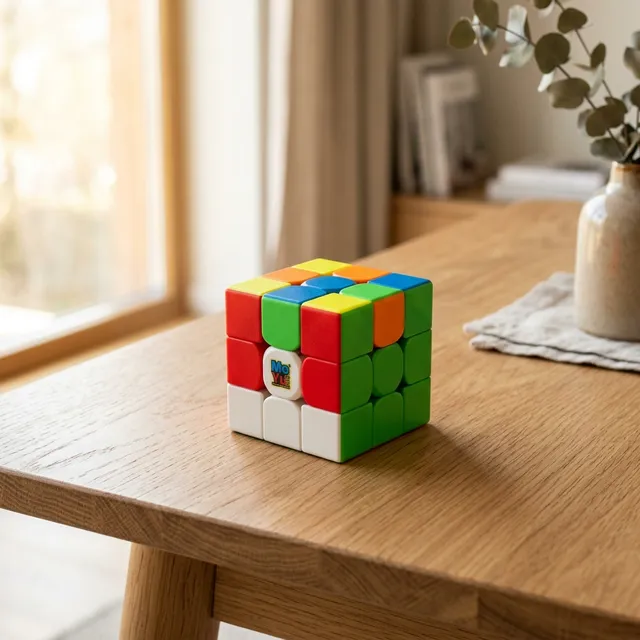
The word “algorithm” scares people away from the Rubik’s Cube more than any other single thing.
You read a tutorial that says “now perform R U R’ U’ six times” and your brain files the entire experience under “not for me.” You see someone rattle off a sequence of twelve moves from memory and think: I could never memorize all that. The cube goes back on the shelf.
But here is the thing most tutorials never tell you: you do not need algorithms for most of the Rubik’s Cube. The majority of the puzzle can be solved with nothing but logic, spatial reasoning, and a bit of patience.
The real question is not “can you solve it without algorithms?” It is “how far can you get before you need them?”
The answer: further than you think.
What People Mean When They Say “Algorithm”
Before we go further, it is worth untangling what “algorithm” actually means on a Rubik’s Cube — because the cubing community uses the word in a way that makes the puzzle sound harder than it is.
In cubing, an algorithm is just a specific sequence of moves that achieves a specific result. Turn the right face up, the top face clockwise, the right face down, the top face counterclockwise — that is an algorithm. Four moves. It is not calculus. It is not a formula. It is more like a recipe: do these things in this order and you will get this result.
The problem is that the word “algorithm” carries baggage. It sounds mathematical. It sounds like something you need to study. When a tutorial says “now apply this algorithm,” most beginners hear “now do something beyond your ability.”
In reality, every time you figure out how to move a piece from one spot to another, you are performing an algorithm — you just invented it on the fly instead of reading it from a list. The difference between “intuitive solving” and “using algorithms” is more about how you learned the moves than what the moves actually are.
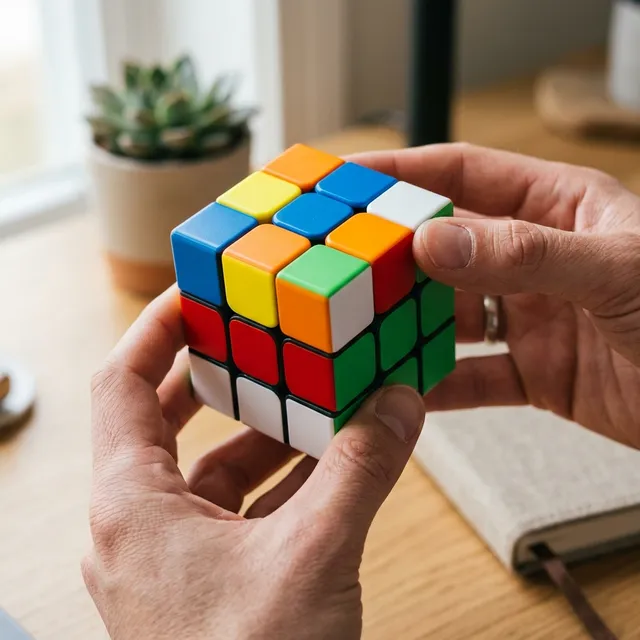 Above: Two layers solved with pure logic. The last layer is where intuition alone stops being enough — but getting here is a genuine achievement.
The First Two Layers: Pure Logic
Here is the good news. The first two layers of the Rubik’s Cube — roughly two-thirds of the puzzle — can be solved entirely through intuition.
The white cross
The very first step in most beginner methods is making a cross on one face (usually white). This requires no memorization at all. You look at a white edge piece, figure out where it needs to go, and work out how to get it there. It is a spatial puzzle, and your brain is built for exactly this kind of thinking.
Most people can figure this out within a few minutes of picking up the cube. It is satisfying, immediate, and fully intuitive.
The white corners
Next, you fill in the four corner pieces of the white face. Again, this is logic. You find a white corner piece, look at its other two colors to figure out where it belongs, and maneuver it into position. There are only a few possible situations, and with a little experimenting you can solve all of them without anyone telling you a sequence to memorize.
The middle layer edges
The four edge pieces of the middle layer can also be solved intuitively. You find an edge on the top layer, figure out which slot it belongs in, and work out a way to slot it in without disturbing the white face you already completed. This takes a bit more thought, but the logic is the same: see the piece, find the destination, figure out the path.
An experienced cuber doing this intuitively calls it “intuitive F2L” — First Two Layers. It is one of the most respected skills in cubing, and it requires zero memorization. You are solving the cube the way Erno Rubik himself did: by understanding what your moves do and using that understanding to get pieces where they need to go.
The Last Layer: Where Logic Hits a Wall
And then you reach the last layer. And everything changes.
The last layer is hard for a specific, structural reason: every move you make now affects pieces you have already solved. On the first two layers, you could work on the top of the cube without worrying about the bottom. That safety net is gone.
To move a last-layer piece into its correct position without permanently displacing something below it, you need a sequence of moves that is designed to have a very specific effect while leaving everything else untouched. These sequences were not discovered through intuition — they were found through mathematical analysis.
This is where the “you need algorithms” advice comes from, and it is not wrong. The last layer is genuinely difficult to solve through pure logic alone. For a full breakdown of why, see The Last Layer: Why Everyone Gets Stuck Here.
How difficult? When people on forums describe solving the entire cube without any help, the first two layers typically take a few days. The last layer takes weeks. In some cases, months. One person described their self-discovered last-layer sequence as 78 moves long — a beginner method algorithm does the same thing in 6.
Erno Rubik himself spent a full month solving his own invention, and the last layer was the part that took the longest.
So yes, you can solve the last layer without memorized algorithms. People have done it. But it requires either deep mathematical insight or an enormous amount of trial and error. For most people, it is not a realistic path.
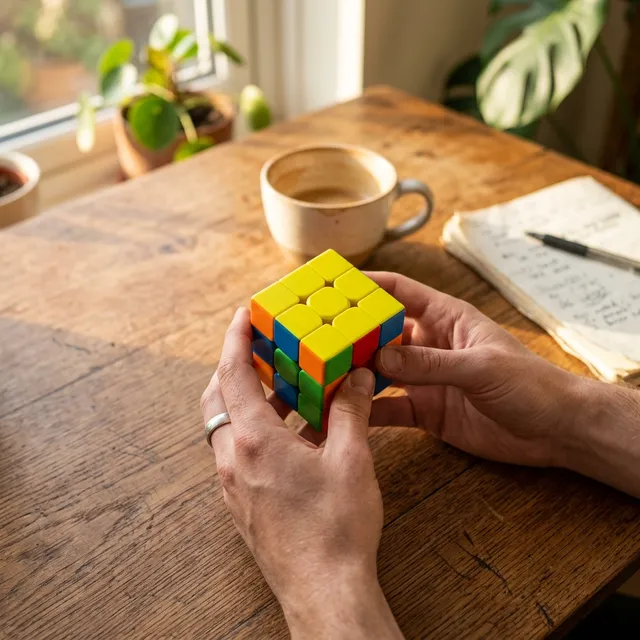 Above: The last layer is where “just figure it out” stops working. The moves required to solve it without disturbing the first two layers are not intuitive — they were mathematically discovered.
The Middle Path: Understanding Without Memorizing
Here is where the real answer lives — and it is the one most tutorials skip over.
You do not have to choose between “figure it out yourself from scratch” and “memorize a list of letter sequences you do not understand.” There is a middle ground.
The beginner method for the last layer uses about four short sequences. Each one is between 6 and 8 moves. And each one does something specific and understandable:
- One makes the yellow cross on top.
- One positions the top edges so they match their center colors.
- One cycles three corners into their correct spots.
- One twists the corners so yellow faces up.
You do not need to understand the mathematics behind why these sequences work. But you can understand what each one accomplishes and when to use it. That is not memorization — that is comprehension.
The difference matters. If you memorize a sequence, you can forget it. If you understand what a sequence does and follow it with a guide, you can always do it again. You are not relying on your memory — you are relying on a tool.
This is exactly how most people learn to cook. You do not memorize the recipe for bread. You follow it. And each time you follow it, you understand a little more about why each step exists. Eventually, you can improvise. But nobody expects you to invent bread from scratch on your first day in the kitchen.
What CubeUnstuck Does With This Idea
CubeUnstuck is built on a simple premise: you should never need to memorize anything to solve a Rubik’s Cube.
The first two layers are already intuitive. CubeUnstuck makes them even more approachable by scanning your specific cube and showing you — with visual arrows on a 3D model — exactly which piece to focus on and where to move it. You are still using your logic. The app just makes sure you never get lost.
For the last layer, where pure intuition runs out, CubeUnstuck replaces memorization with guided steps. Instead of giving you a sequence like R U R’ U R U2 R’ and saying “good luck,” it shows you one single turn at a time. A glowing halo around the face you need to turn. An arrow showing which direction. Voice narration telling you what to do so your hands never leave the cube.
You are not memorizing. You are not decoding notation. You are following a guide that knows what your cube looks like right now and tells you the exact next move.
The result is that you solve the last layer the same way you solved the first two: by doing one thing at a time and seeing the result. The only difference is that for the last layer, the guide is doing the planning. You are doing the turning.
Once you have done it a few times, something interesting happens. The sequences start to feel familiar. Not because you sat down and memorized them, but because your hands remember the motions. This is the difference between cramming for a test and learning by doing — the learning sticks.
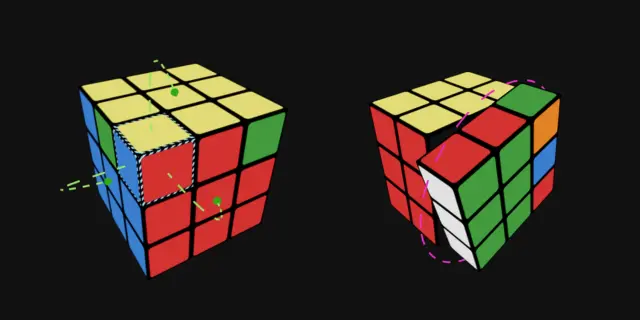 Above: CubeUnstuck replaces memorization with one-move-at-a-time guidance. You follow the visual cue, make the turn, and see what changed — no sequences to remember.
The Honest Answer
Can you solve a Rubik’s Cube without algorithms? Technically, yes. Erno Rubik did. A handful of patient, determined people on forums have done it in weeks or months.
But the better question is: do you need to memorize algorithms? No. Not if you have a guide that handles the complex parts while you focus on the doing.
The first two layers are yours to figure out. They are a genuine logic puzzle, and solving them with your own reasoning is deeply satisfying. The last layer is a wall — but it is a wall that a good guide can walk you through, one step at a time, without requiring you to memorize a single thing.
The Rubik’s Cube is not a memory test. It is a puzzle. And puzzles are meant to be solved, not studied.